Slide patterns
Choose a complete slide recipe by what the slide needs to do, then edit the installed React source when the recipe needs to change.
Deckard calls the source files blocks. Authors usually need a recipe: a whole-slide frame paired with the content block that belongs inside it. The visual gallery is a representative subset. The intent index below covers every author-facing pattern.
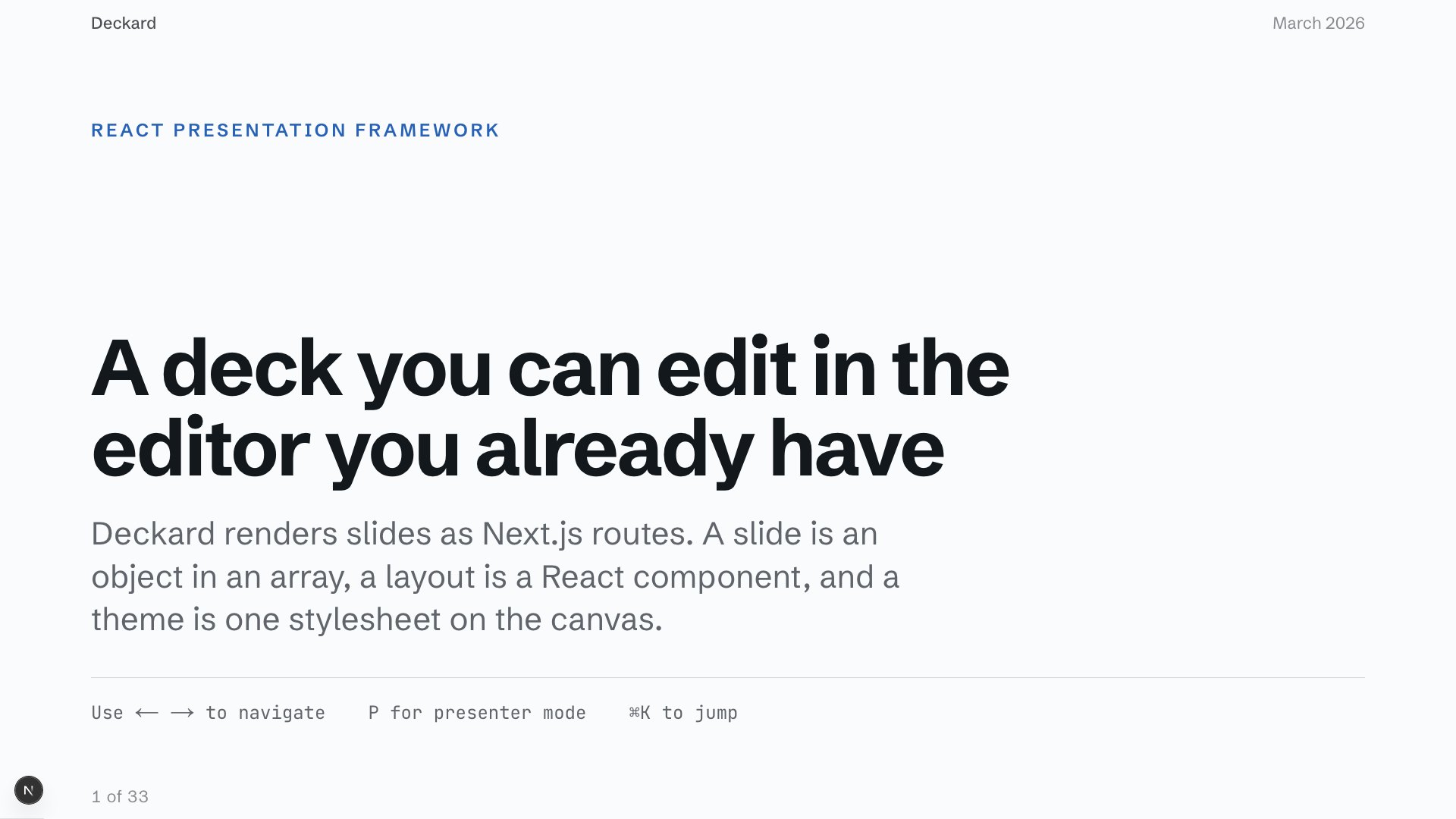
Start and divide
Whole slideOpener
HeroSlideUse this when one title and one line need the whole room.
Show composition
<HeroSlide eyebrow="Engineering all-hands" title="What we shipped" />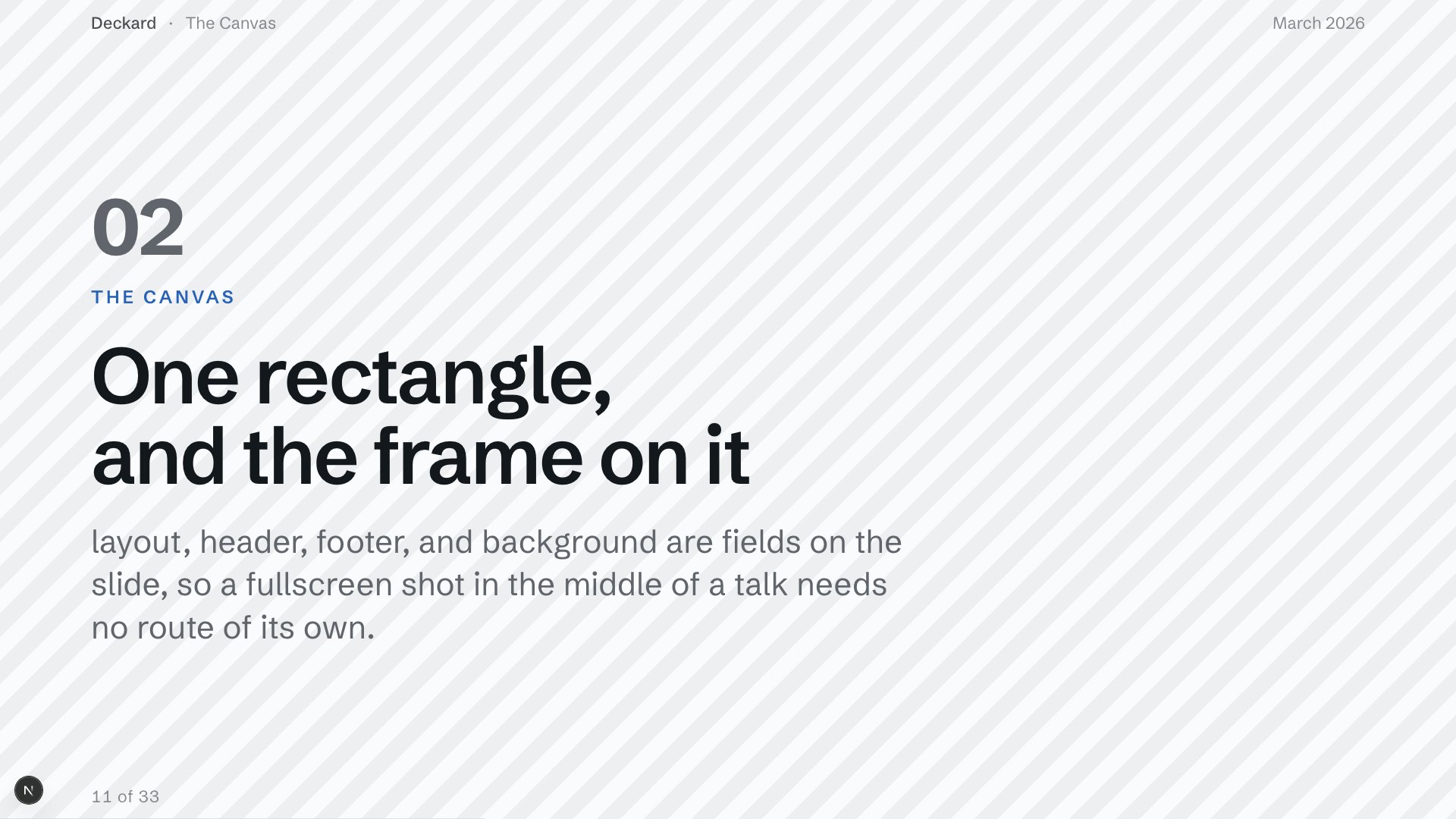
Start and divide
Whole slideSection break
BreakerSlideUse this to reset the room before the next part of the argument.
Show composition
<BreakerSlide eyebrow="The trade" title="What it cost" description={summary} />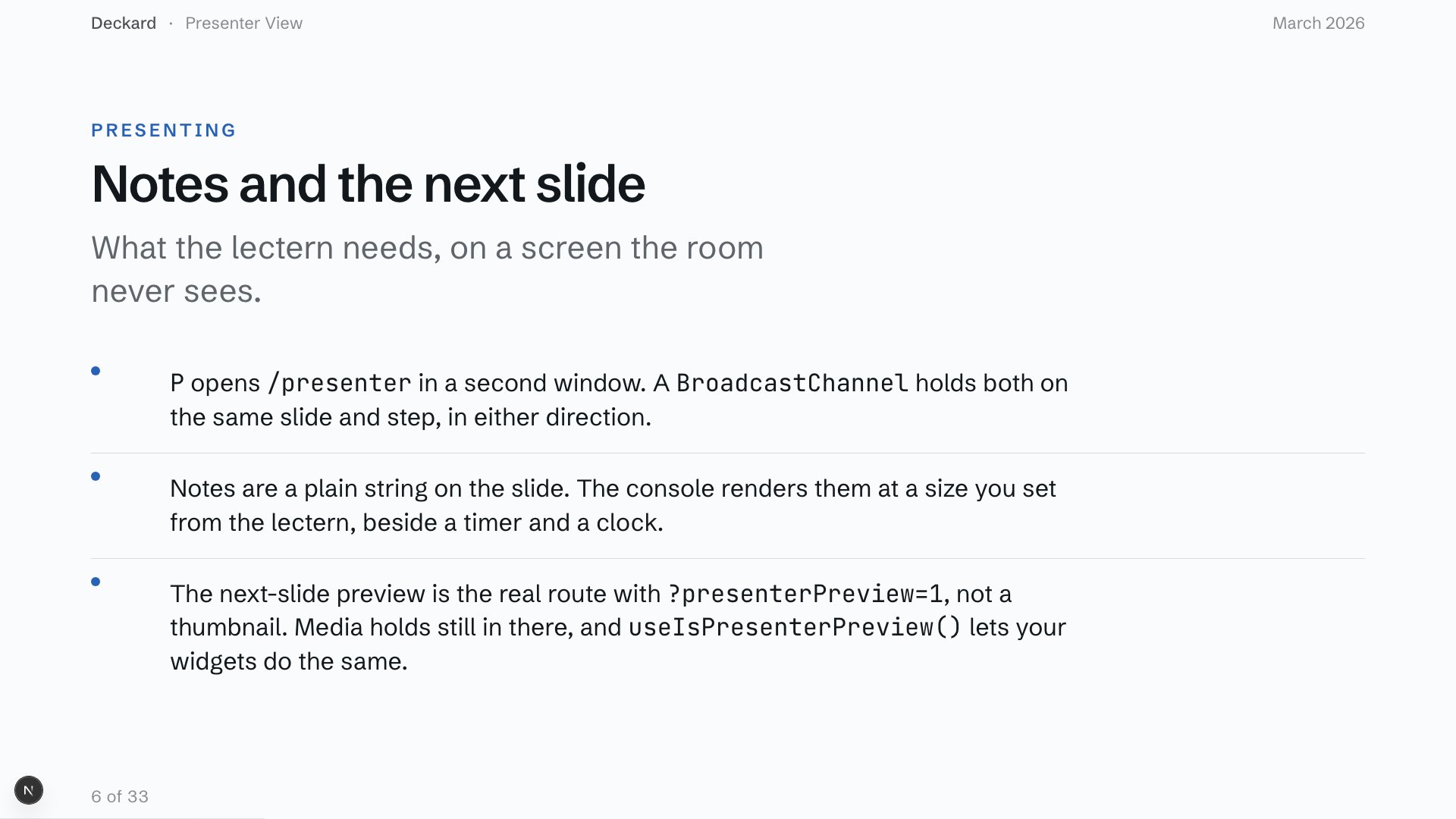
Explain and emphasise
Slide recipeNumbered argument
OpenContentSlide + BulletListUse this when the order matters and each point earns a full sentence.
Show composition
<OpenContentSlide title="How we got there"><BulletList items={points} /></OpenContentSlide>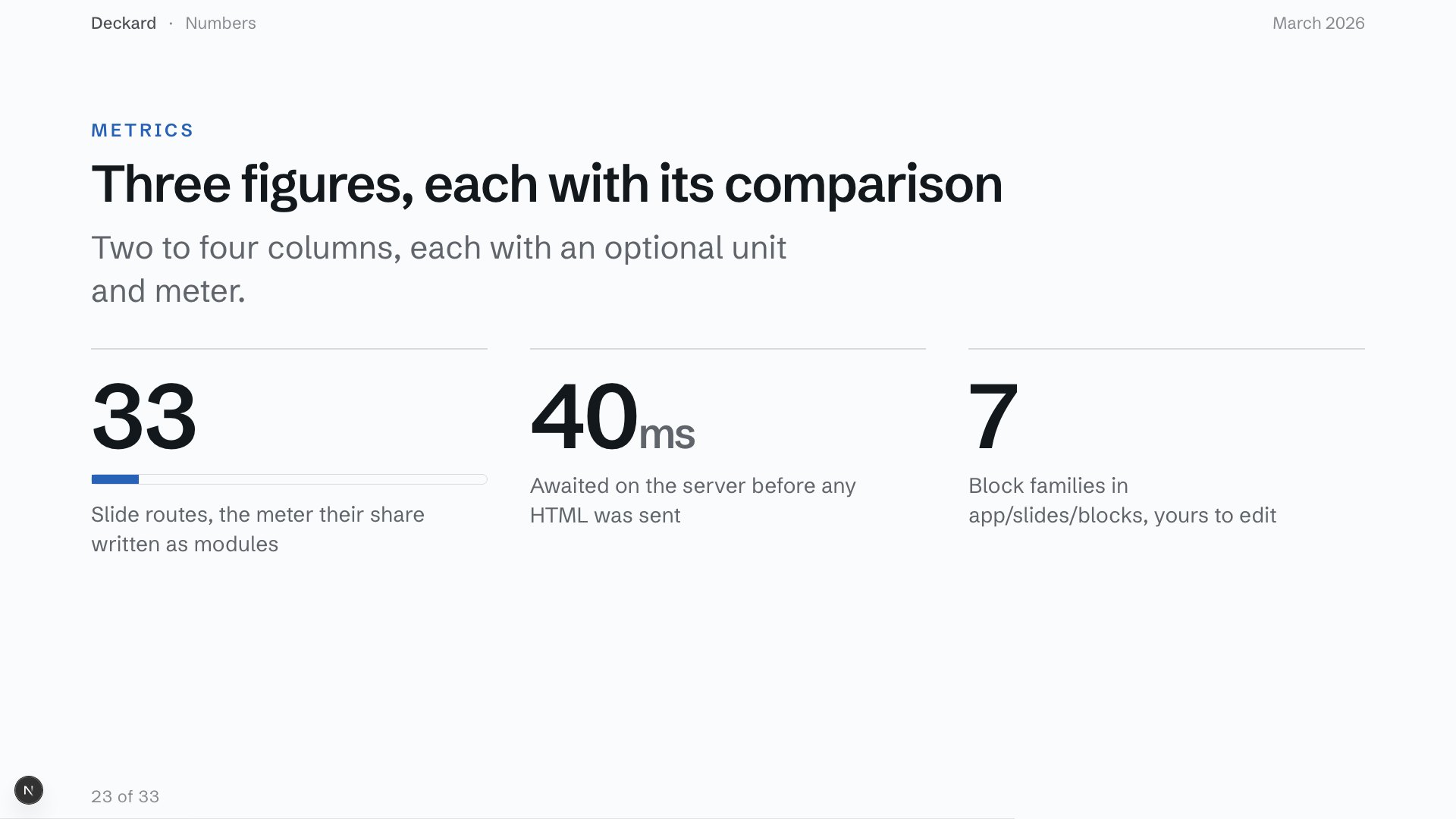
Show data and activity
Slide recipeKey figures
OpenContentSlide + StatGridUse this when a small set of numbers carries the argument.
Show composition
<OpenContentSlide title="The numbers"><StatGrid items={figures} /></OpenContentSlide>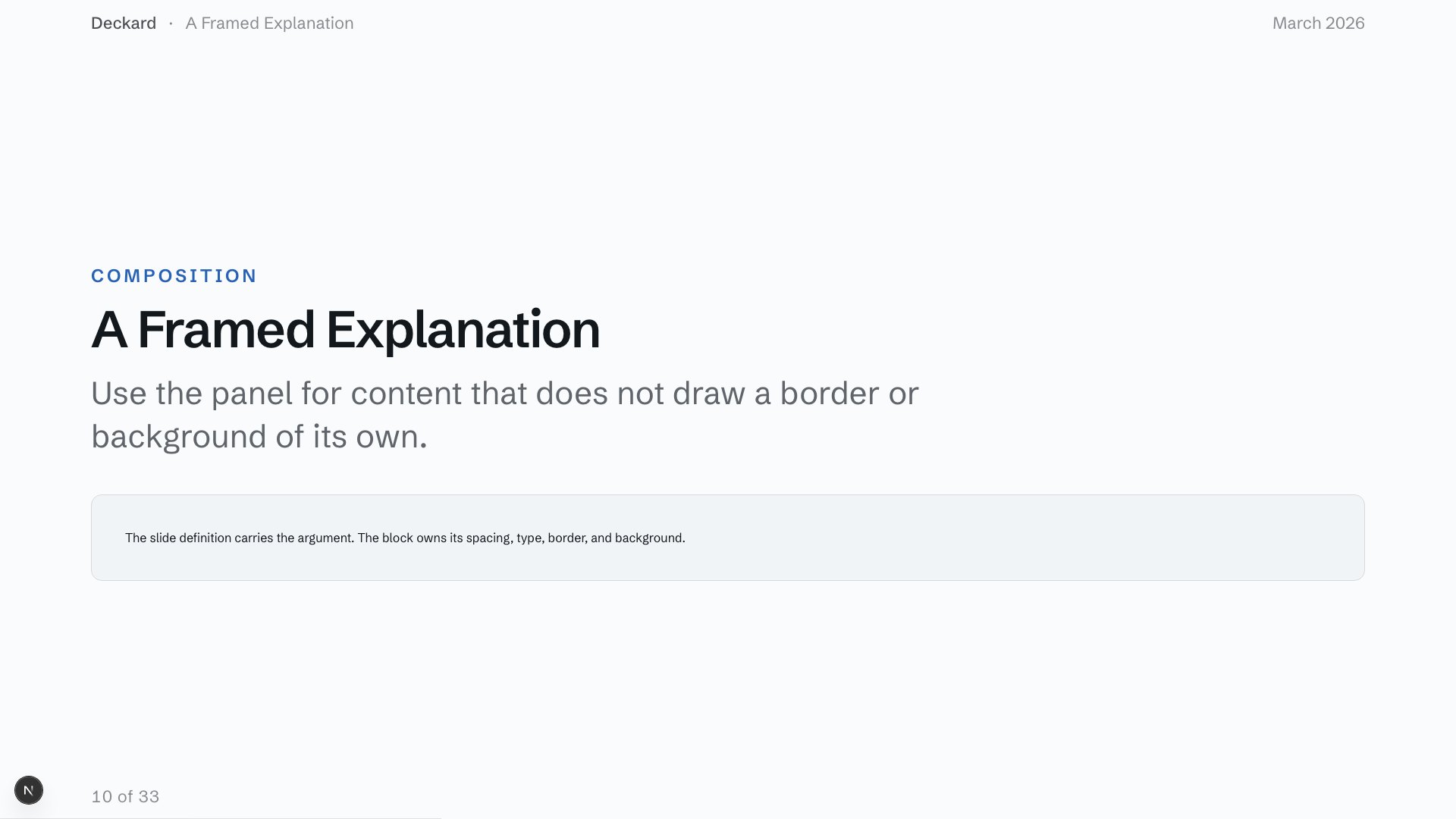
Explain and emphasise
Whole slideFramed explanation
ContentSlideCardUse this for flat prose or a definition that needs one clear frame.
Show composition
<ContentSlideCard title="The decision"><p>{explanation}</p></ContentSlideCard>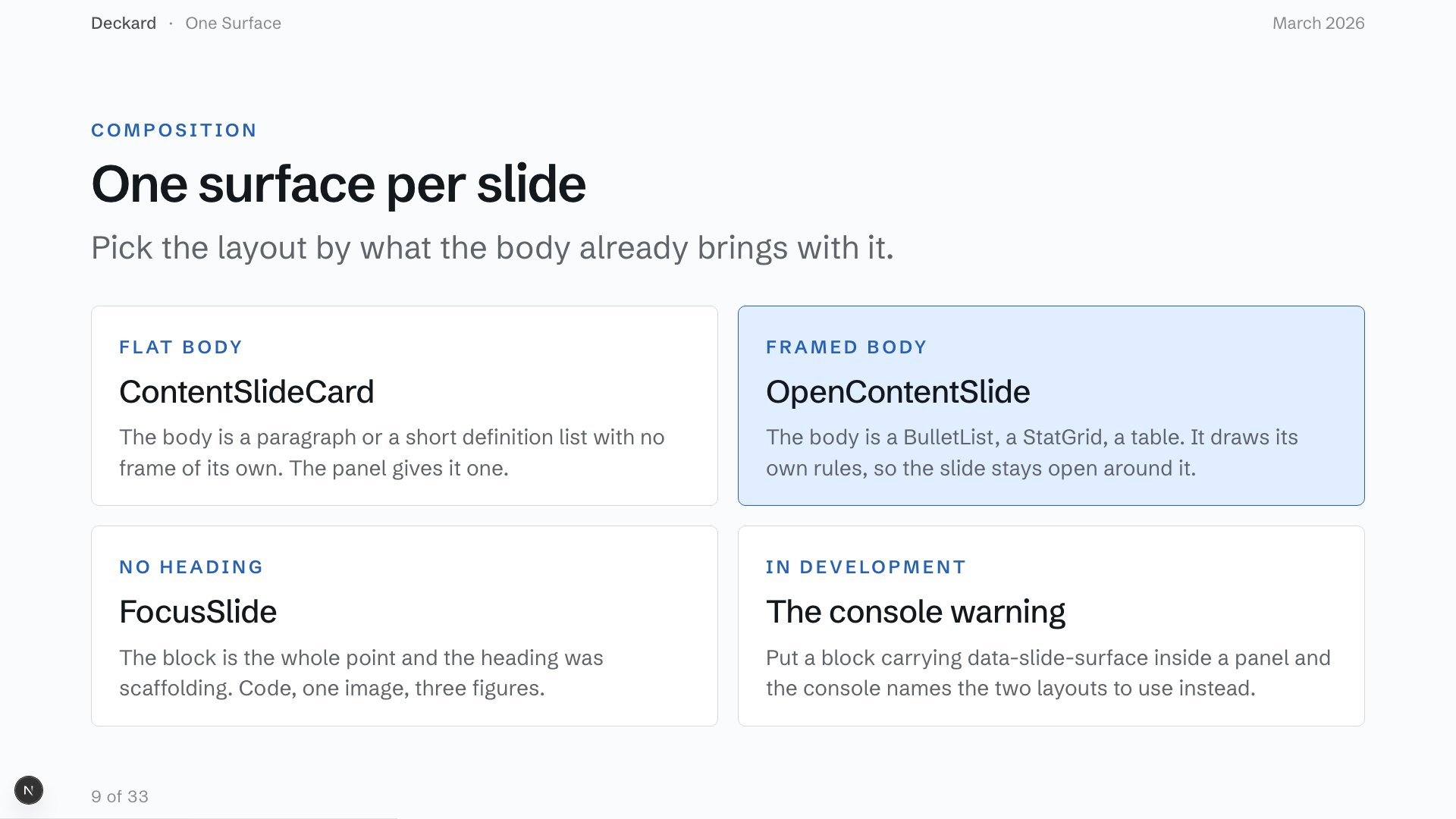
Compare and organise
Slide recipeOption comparison
OpenContentSlide + CardGridUse this when each alternative needs a name and a short explanation.
Show composition
<OpenContentSlide title="Three ways forward"><CardGrid items={options} /></OpenContentSlide>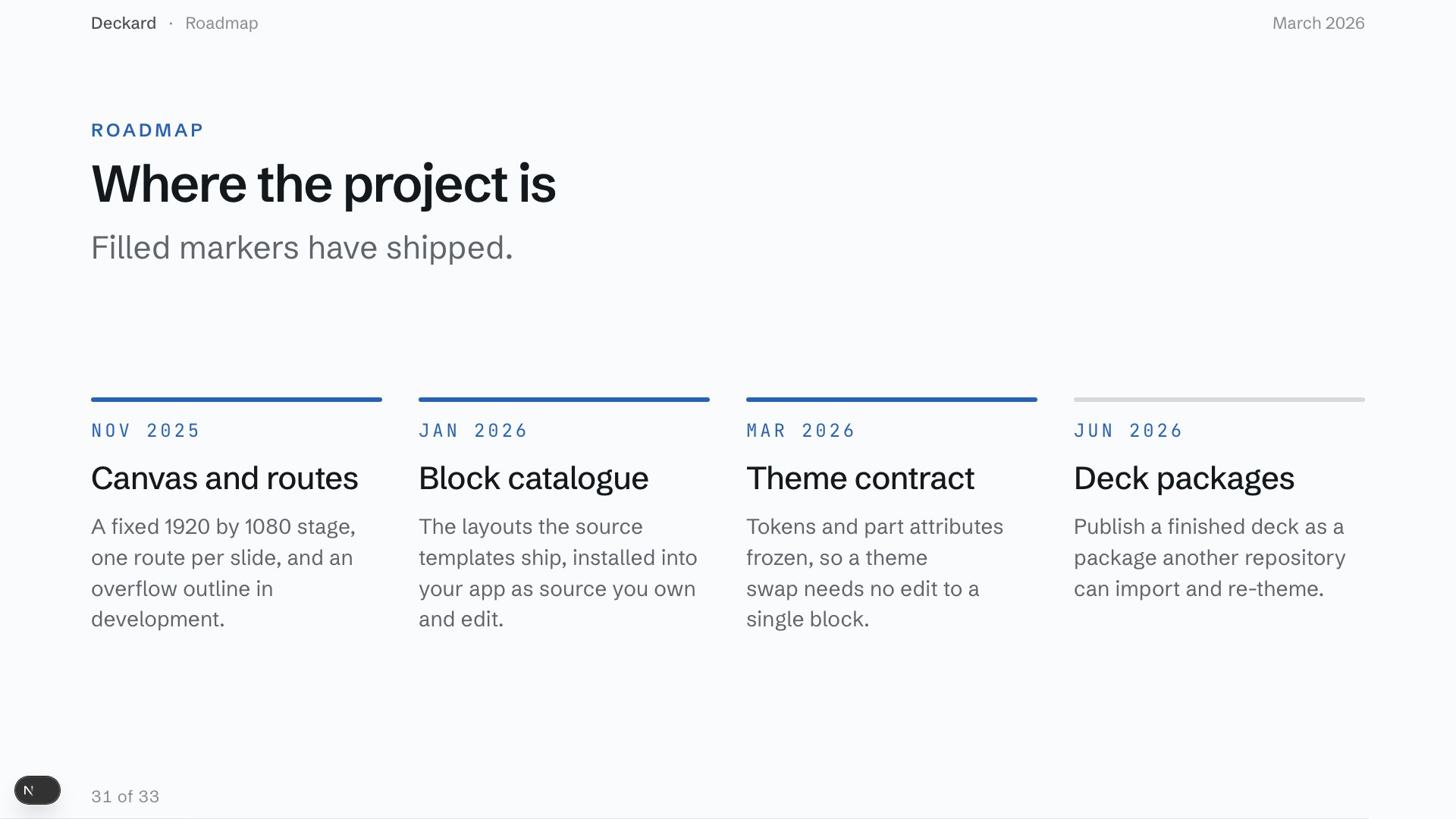
Compare and organise
Slide recipeRoadmap
OpenContentSlide + TimelineUse this when dates and sequence matter more than exact duration.
Show composition
<OpenContentSlide title="The next release"><Timeline items={milestones} /></OpenContentSlide>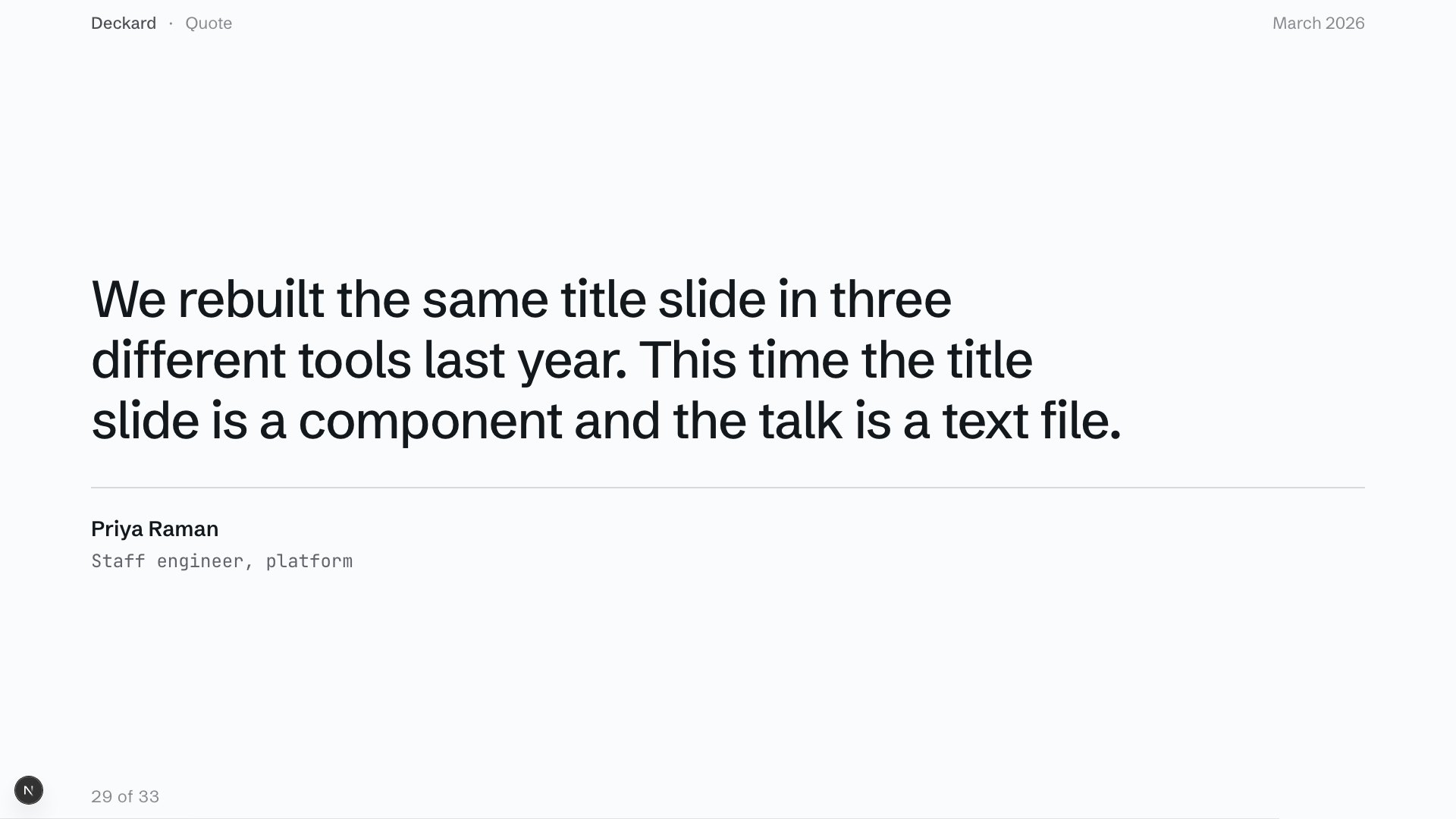
Explain and emphasise
Whole slidePull quote
QuoteSlideUse this when someone else's sentence is the evidence.
Show composition
<QuoteSlide attribution="Maya Chen" quote={quote} />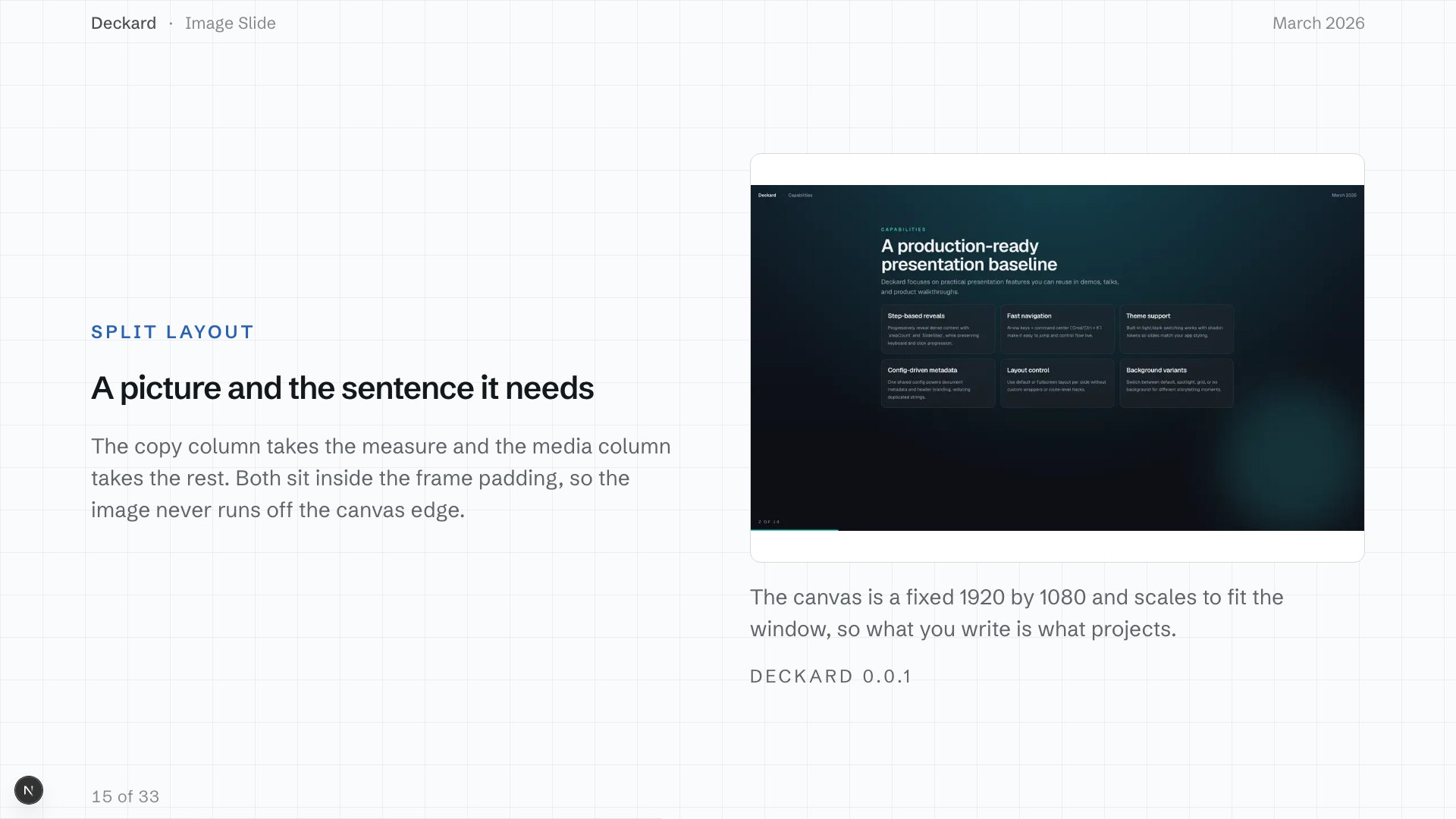
Show media
Whole slideImage and explanation
ImageShowcaseSlideUse this when the image needs context beside it rather than text on top.
Show composition
<ImageShowcaseSlide image={image}><SlideHeading title="Field notes" /></ImageShowcaseSlide>Representative recipes
| Pattern | Level | Use it for | Example |
|---|---|---|---|
HeroSlide |
Whole slide | Open with the talk’s title and premise. | Opener |
BreakerSlide |
Whole slide | Mark a section change. | Section break |
OpenContentSlide with BulletList |
Slide recipe | Explain a short set of points. | Bullets |
OpenContentSlide with StatGrid |
Slide recipe | Report a small set of figures. | Figures |
ContentSlideCard |
Whole slide | Put flat prose or custom markup in one panel. | Content card |
OpenContentSlide with CardGrid |
Slide recipe | Compare options or grouped ideas. | Cards |
OpenContentSlide with Timeline |
Slide recipe | Show a sequence or plan. | Timeline |
QuoteSlide |
Whole slide | Give one quotation the canvas. | Quotation |
ImageShowcaseSlide |
Whole slide | Pair one image with its context. | Image |
Choose the frame first
Use HeroSlide, BreakerSlide, StatementSlide, QuoteSlide, and ProseSlide as complete slides. They own the composition.
Use OpenContentSlide around a block that paints its own border or background, including BulletList, StatGrid, FeatureGrid, CardGrid, DataTable, Timeline, LogList, and RevealList.
Use ContentSlideCard for flat prose or custom markup with no frame of its own. Use FocusSlide when one block is the slide and a heading would repeat what the block already says.
import { OpenContentSlide, StatGrid } from "@/app/slides/blocks"

const figures = [
  { value: "6.2s", caption: "Median build time" },
  { value: "0", unit: "%", caption: "Slides fixed after export" },
] as const

<OpenContentSlide eyebrow="Quarter in review" title="The numbers that moved">
  <StatGrid items={figures} />
</OpenContentSlide>
Find a pattern by intent
| You need to | Start with |
|---|---|
| Open the talk | HeroSlide, HeroSplitSlide, or HeroCenteredSlide |
| Show the talk’s structure | OpenContentSlide with ContentsList |
| Introduce a section | BreakerSlide or MinimalBreakerSlide |
| Land one claim | StatementSlide |
| Explain one code sample | CodeSplitSlide |
| Give one custom block the frame | FocusSlide |
| Present a longer passage | ProseSlide |
| Explain ordered points | OpenContentSlide with BulletList |
| Reveal an argument | OpenContentSlide with RevealList |
| Compare options | OpenContentSlide with ColumnGrid, FeatureGrid, or CardGrid |
| Report figures | OpenContentSlide with StatGrid or DataTable |
| Show a plan | OpenContentSlide with Timeline |
| Show an image | ImageShowcaseSlide, MediaPair, MediaGallery, or FullscreenMediaSlide |
| Quote someone | QuoteSlide |
The blocks and registry guide documents installation, composition rules, and the individual source files.