Start and divide
Whole slideOpener
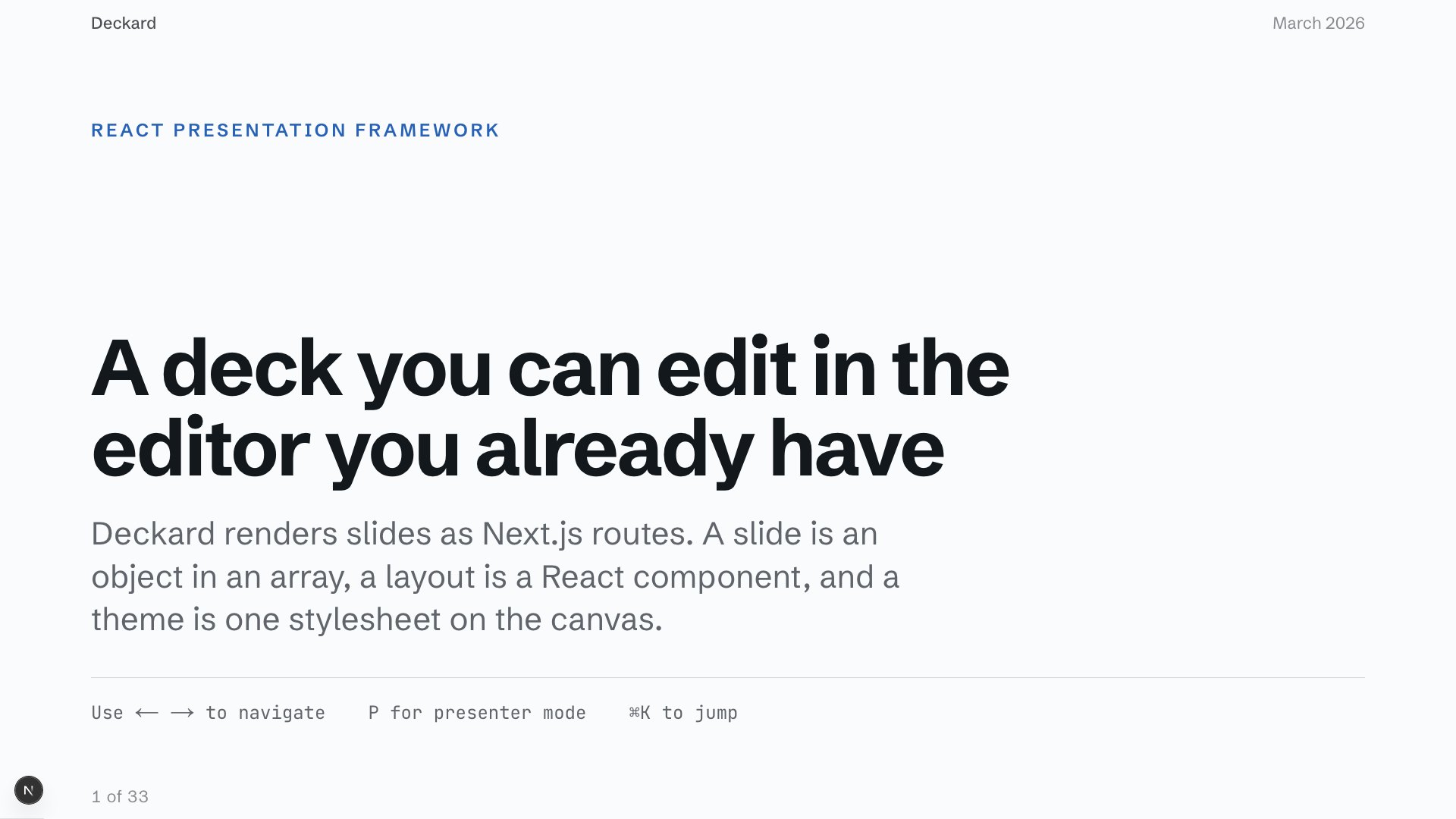
HeroSlideUse this when one title and one line need the whole room.
Show composition
<HeroSlide eyebrow="Engineering all-hands" title="What we shipped" />Start with editable slide patterns and a theme. Add your own React when the talk needs a chart, a live demo, or data loaded by Next.js. Present from the browser, export the PDF, and hand the same source to your coding agent.

npx @thebuilder/deckard-cli init my-talkSet up a new Deckard presentation in ./my-talk with npx @thebuilder/deckard-cli initWrites a Next.js app with a sample deck in it, installs it, and makes the first commit. Deckard is in preview: the API can still move before 1.0.
Paste it into Claude Code, Cursor, or Codex. The agent runs the scaffold and picks up the deck from there.
Choose by what the slide needs to do. Each recipe pairs a whole-slide frame with the content block that fits inside it, and every block lands in your app as editable source.
Start and divide
Whole slideHeroSlideUse this when one title and one line need the whole room.
<HeroSlide eyebrow="Engineering all-hands" title="What we shipped" />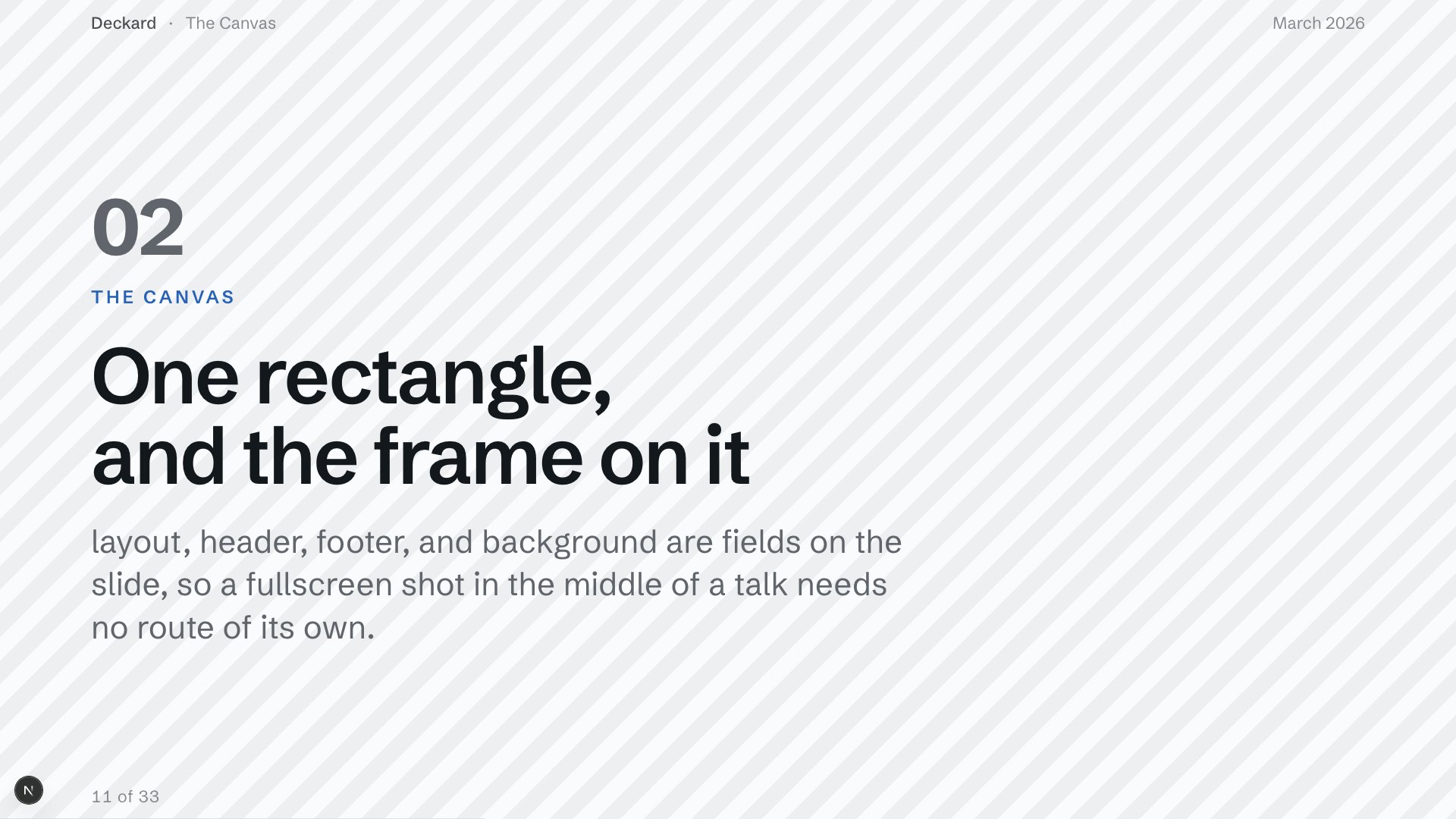
Start and divide
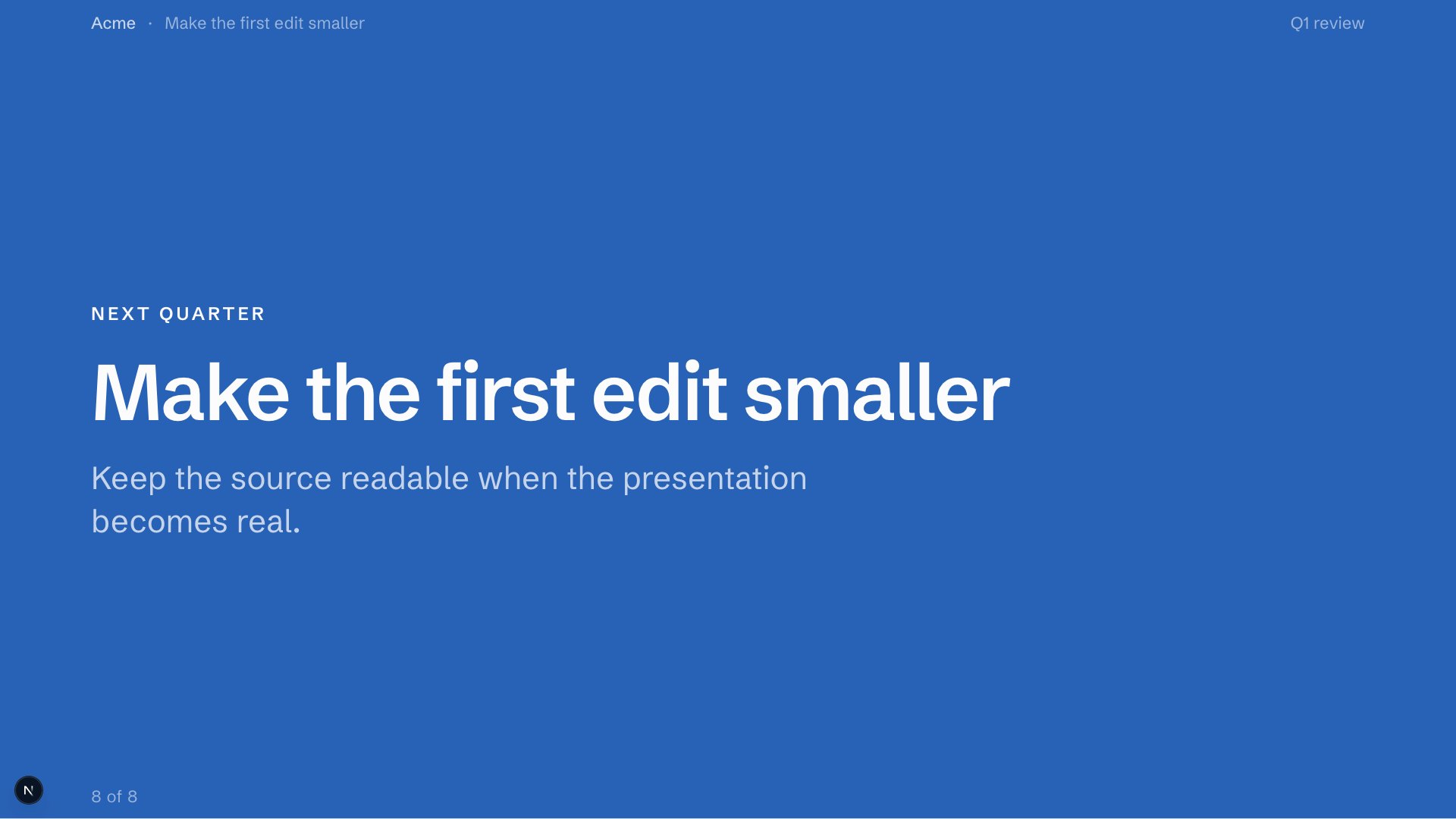
Whole slideBreakerSlideUse this to reset the room before the next part of the argument.
<BreakerSlide eyebrow="The trade" title="What it cost" description={summary} />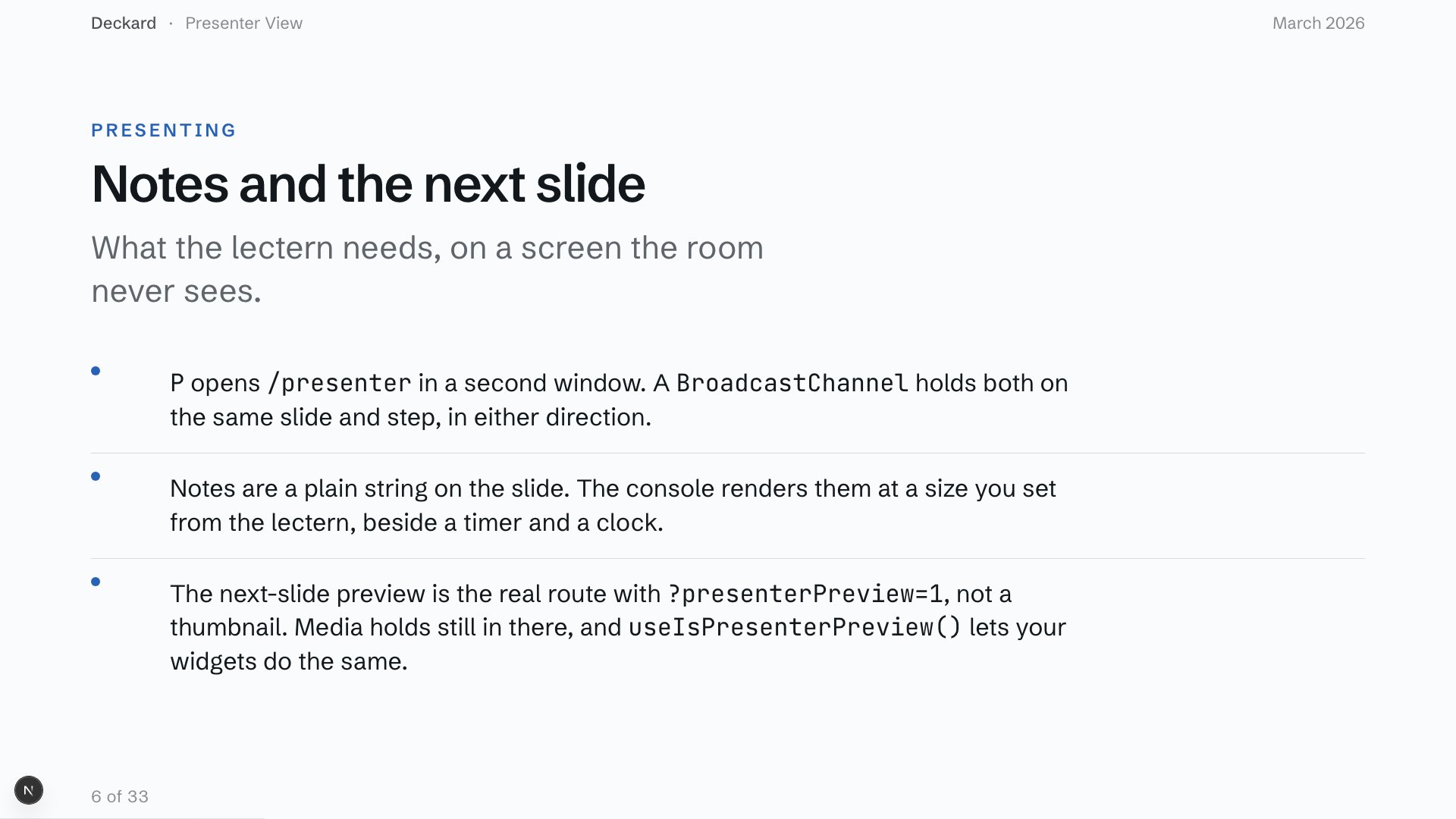
Explain and emphasise
Slide recipeOpenContentSlide + BulletListUse this when the order matters and each point earns a full sentence.
<OpenContentSlide title="How we got there"><BulletList items={points} /></OpenContentSlide>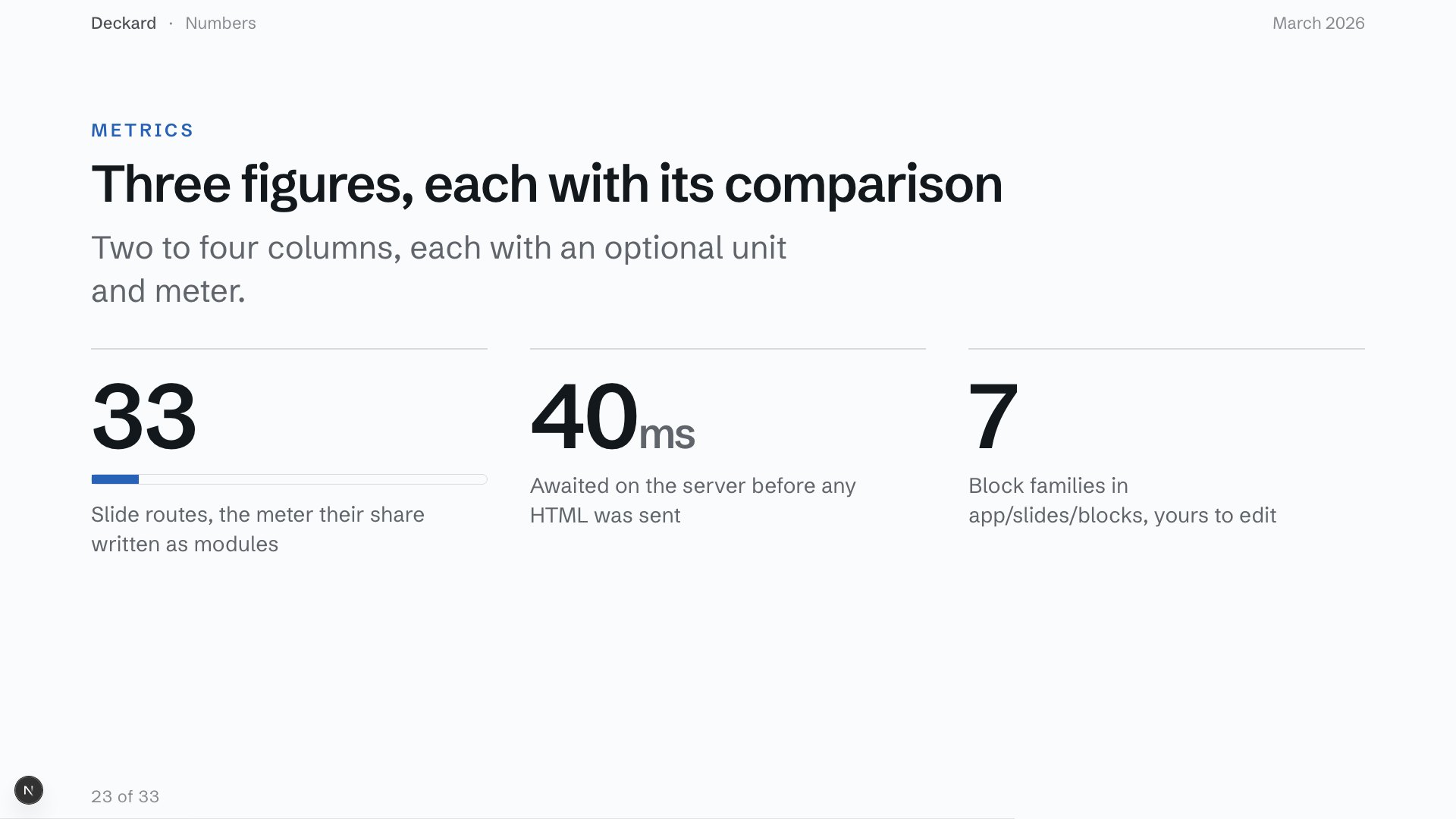
Show data and activity
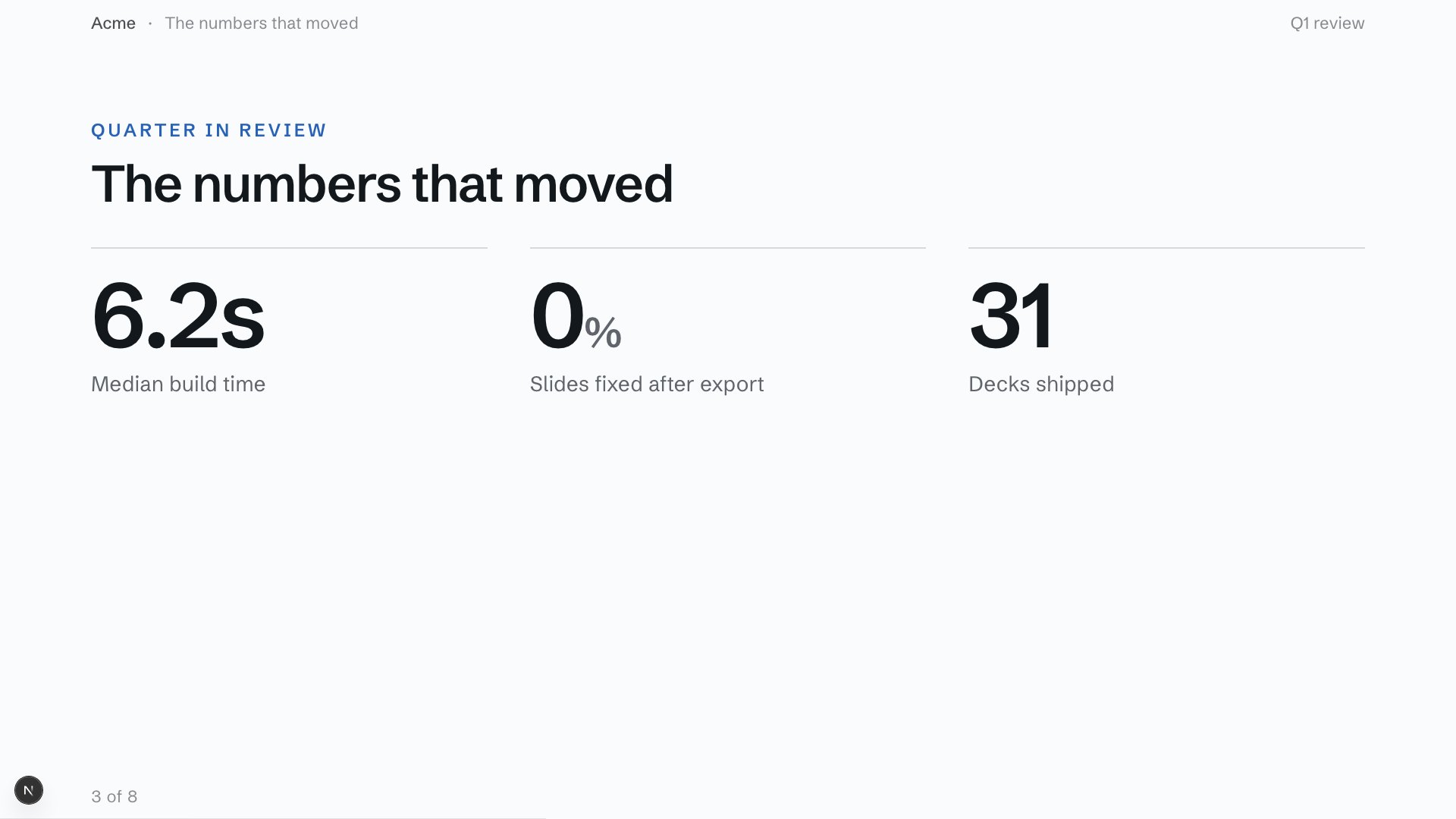
Slide recipeOpenContentSlide + StatGridUse this when a small set of numbers carries the argument.
<OpenContentSlide title="The numbers"><StatGrid items={figures} /></OpenContentSlide>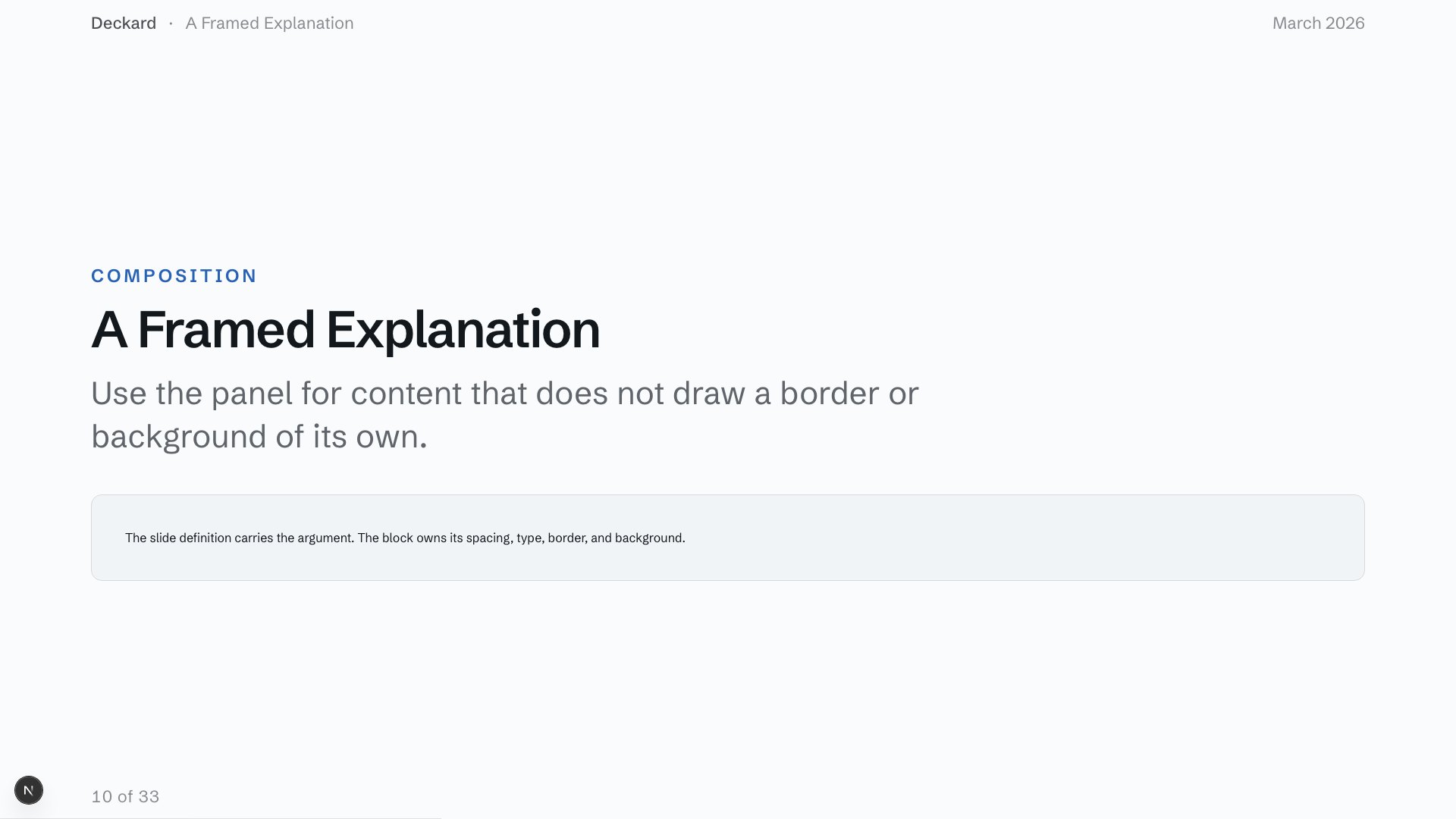
Explain and emphasise
Whole slideContentSlideCardUse this for flat prose or a definition that needs one clear frame.
<ContentSlideCard title="The decision"><p>{explanation}</p></ContentSlideCard>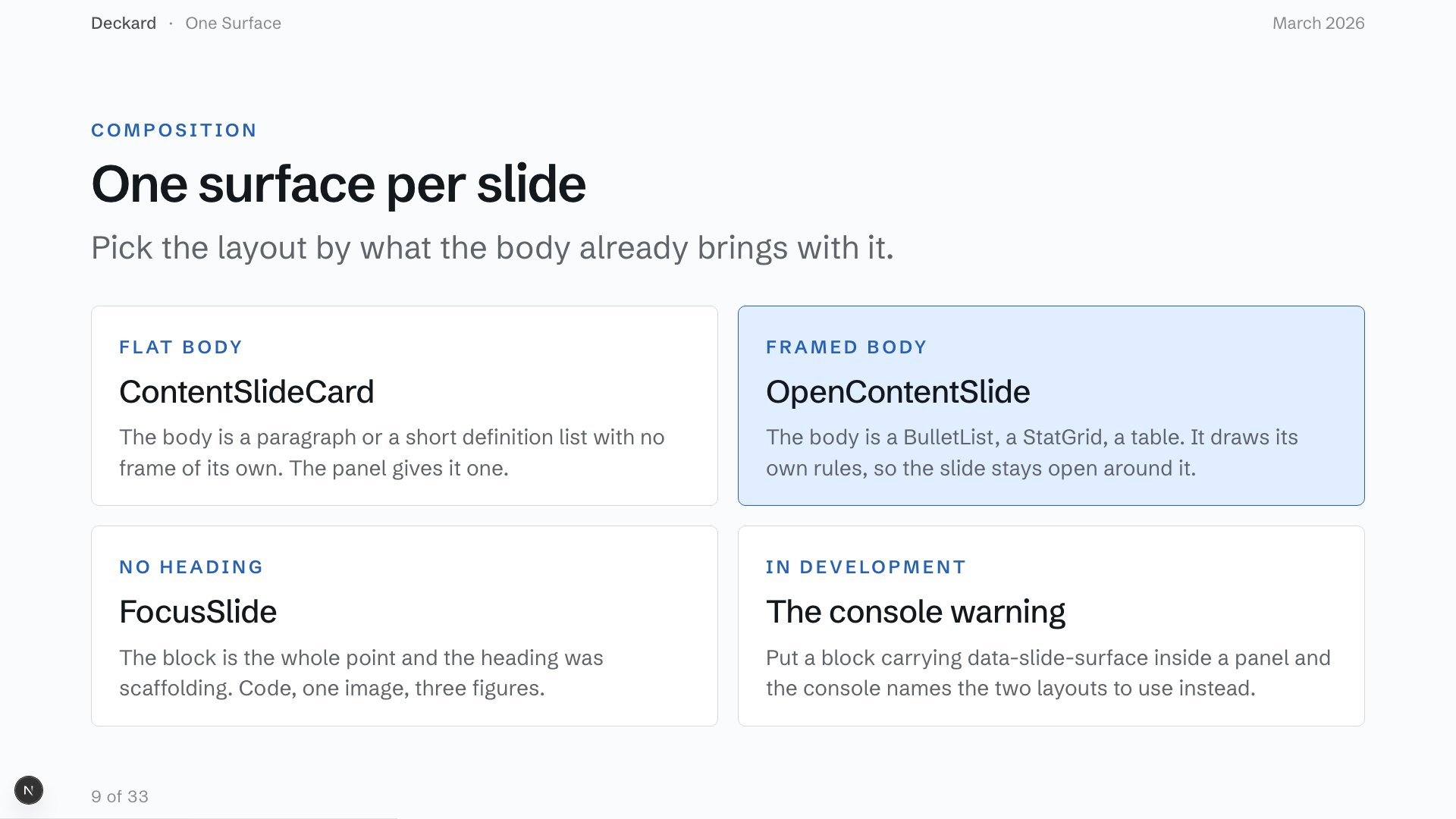
Compare and organise
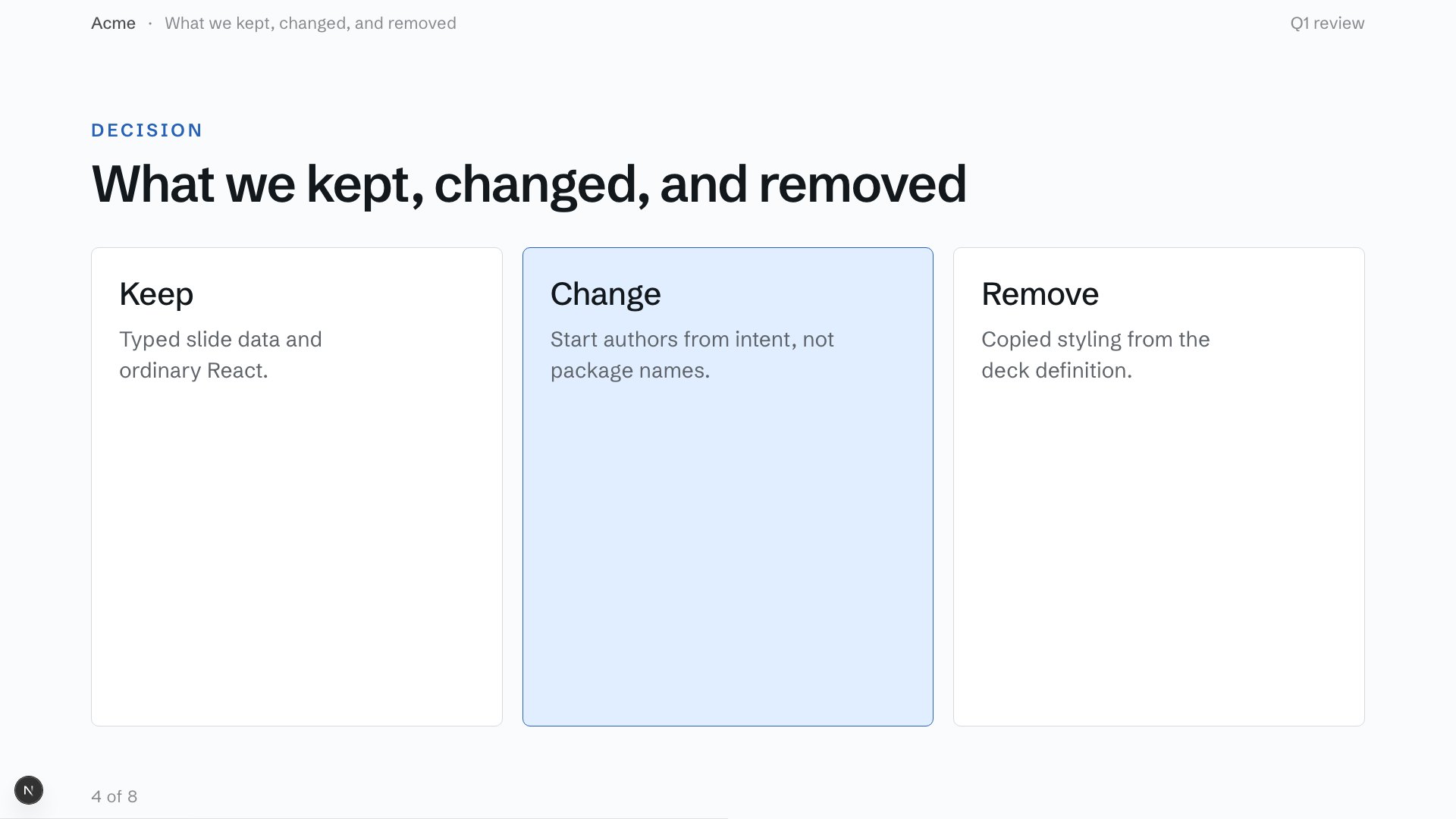
Slide recipeOpenContentSlide + CardGridUse this when each alternative needs a name and a short explanation.
<OpenContentSlide title="Three ways forward"><CardGrid items={options} /></OpenContentSlide>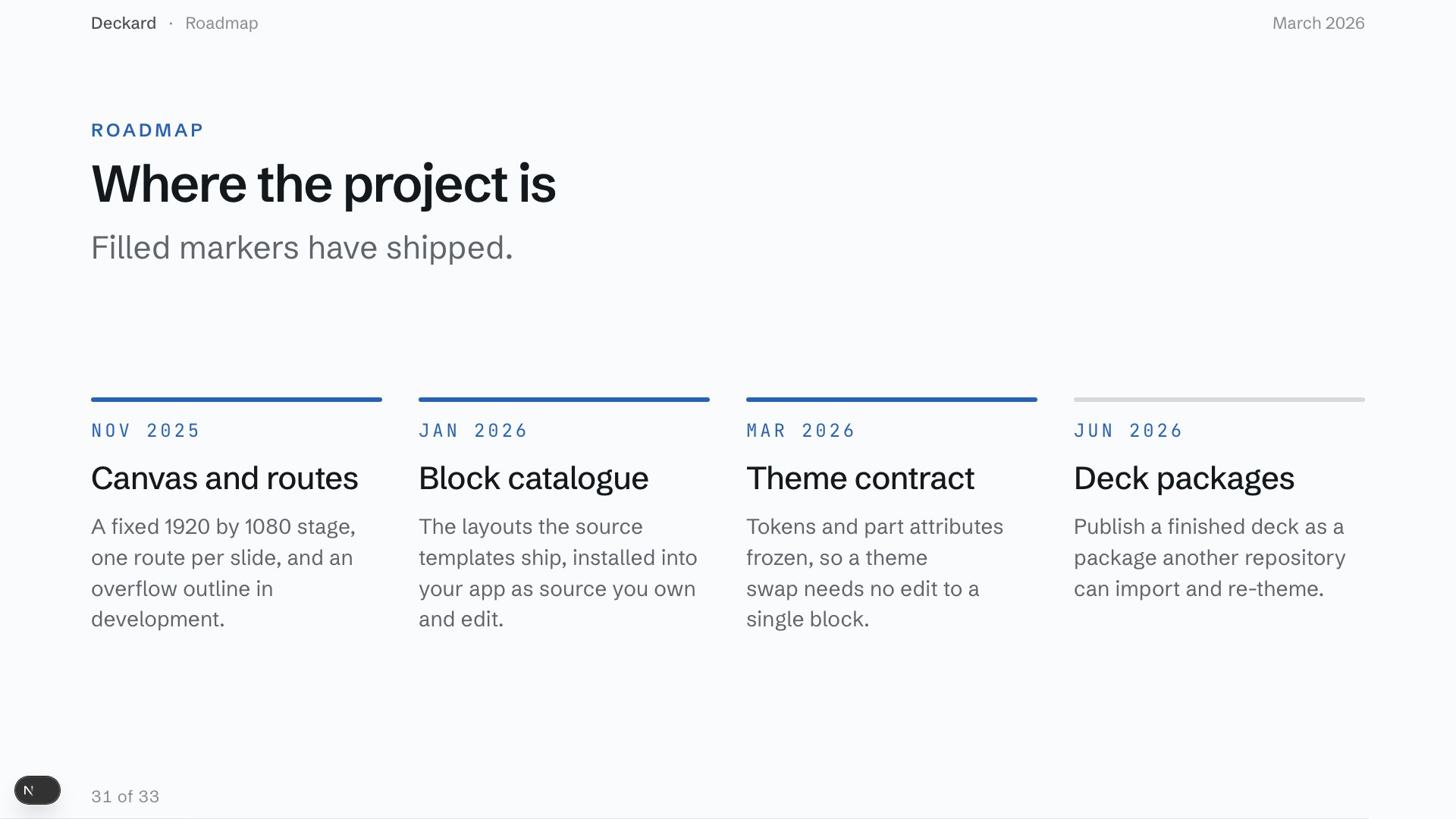
Compare and organise
Slide recipeOpenContentSlide + TimelineUse this when dates and sequence matter more than exact duration.
<OpenContentSlide title="The next release"><Timeline items={milestones} /></OpenContentSlide>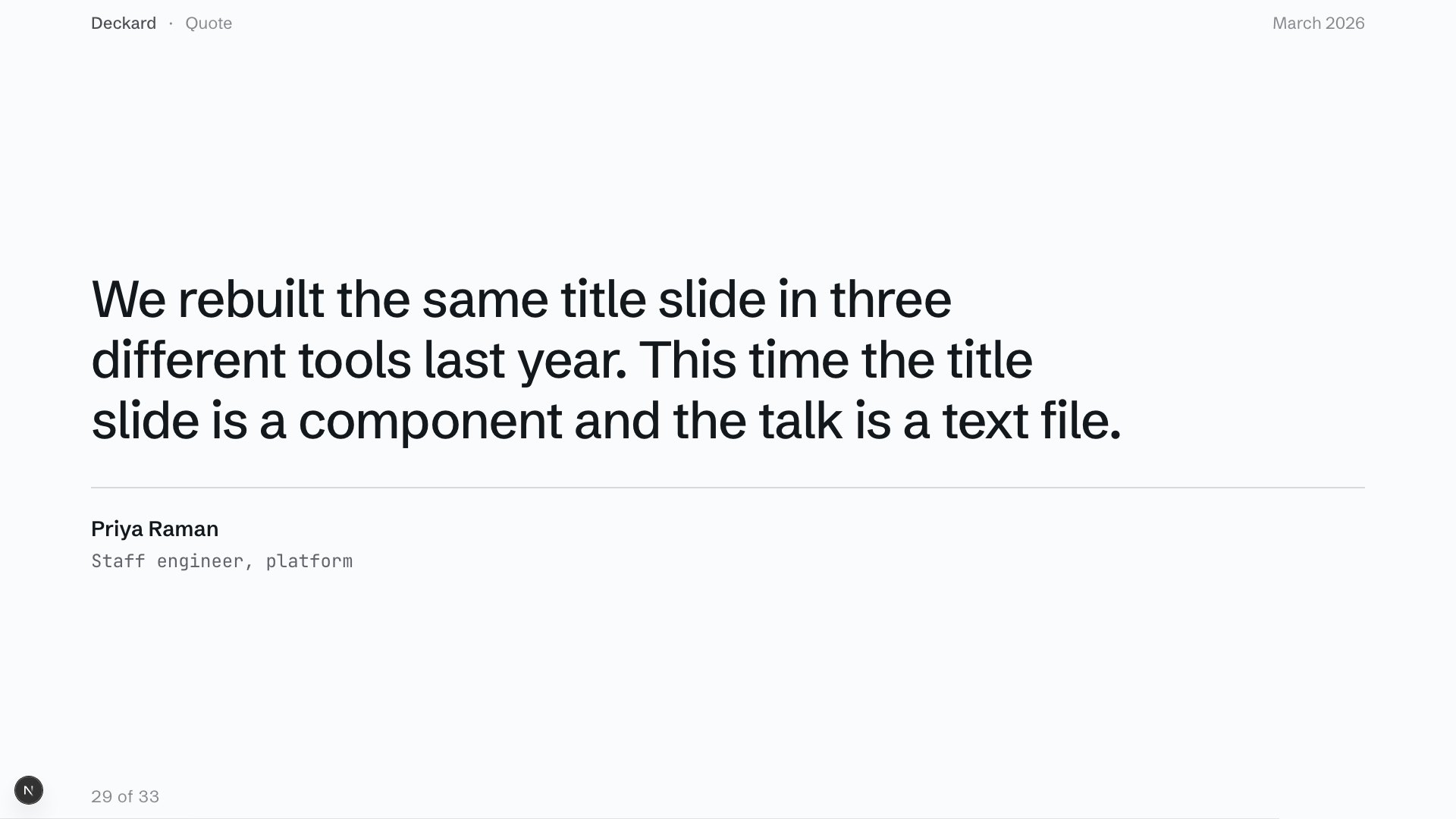
Explain and emphasise
Whole slideQuoteSlideUse this when someone else's sentence is the evidence.
<QuoteSlide attribution="Maya Chen" quote={quote} />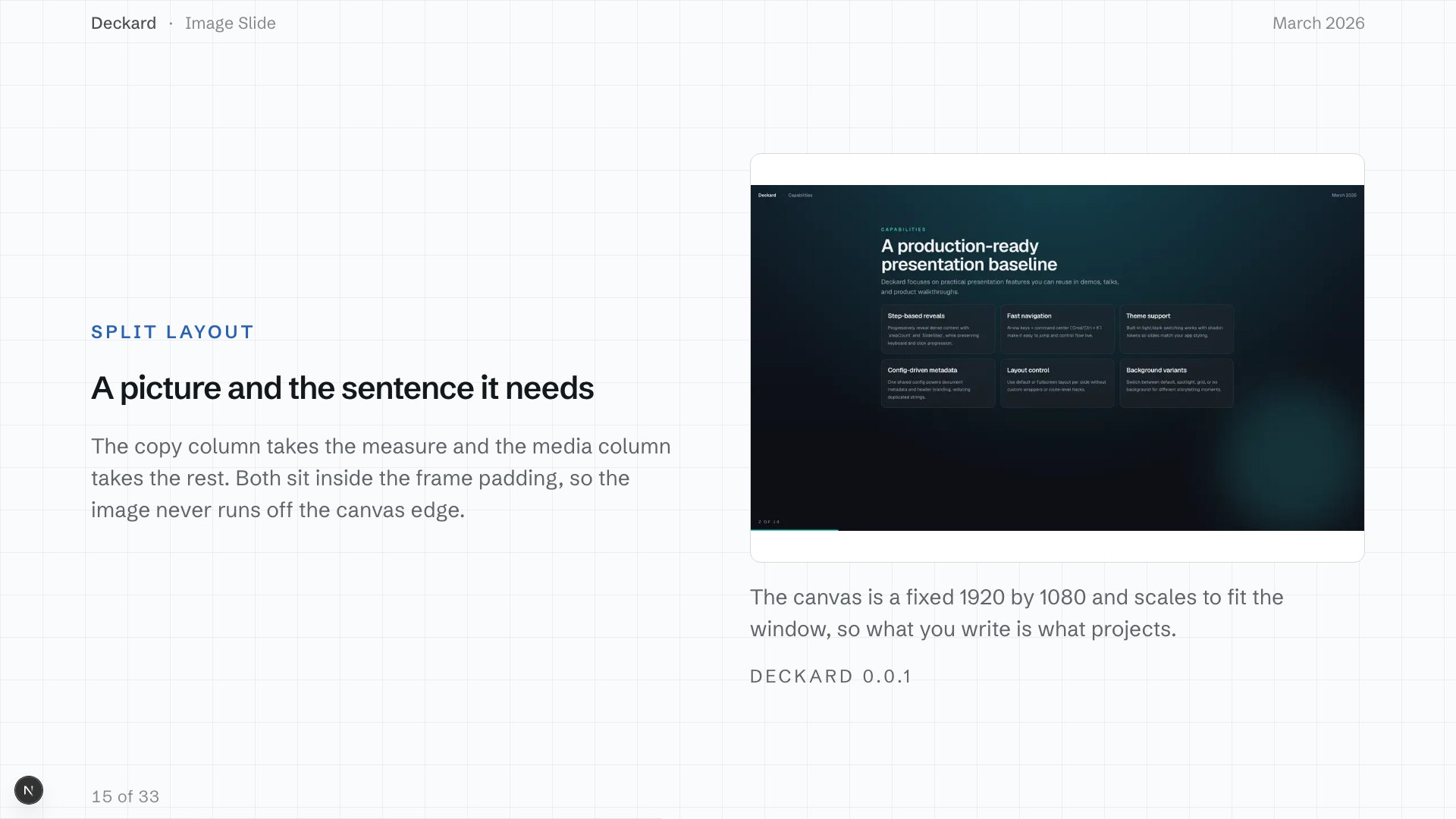
Show media
Whole slideImageShowcaseSlideUse this when the image needs context beside it rather than text on top.
<ImageShowcaseSlide image={image}><SlideHeading title="Field notes" /></ImageShowcaseSlide>Open the pattern guide for composition rules and the full intent index. Explore every Deckard featurein the reference deck.
Your own components, or the layouts Deckard ships. A chart, a table, a code sample, a video, a running demo, data Next.js loaded for you. Pick a slide to see the code behind it.
import type { SlideDefinition } from "@thebuilder/deckard-core"
import {
  BreakerSlide,
  BulletList,
  HeroSlide,
  OpenContentSlide,
  StatGrid,
} from "@/app/slides/blocks"

export const slides: SlideDefinition[] = [
  {
    slug: "intro",
    title: "What we shipped in Q1",
    body: <HeroSlide eyebrow="Engineering all-hands" />,
  },
  {
    title: "The three numbers that moved",
    notes: "Pause on the middle figure. They ask about that one.",
    body: (
      <OpenContentSlide eyebrow="Quarter in review">
        <StatGrid items={quarterly} />
      </OpenContentSlide>
    ),
  },
  {
    title: "How we got there",
    body: (
      <OpenContentSlide eyebrow="The work">
        <BulletList items={decisions} />
      </OpenContentSlide>
    ),
  },
  {
    title: "The bill for all of it",
    background: "spotlight",
    body: (
      <BreakerSlide description={theBill} eyebrow="The trade" />
    ),
  },
]A hero layout: an eyebrow, the title, and one line under it.
A stat grid of three figures. The notes stay off the canvas.
The same slide with a bullet list in it instead.
A section break, painted on the theme's spotlight backdrop.
Server and client components are both supported.
Every slide is drawn on one fixed 1920x1080 canvas that scales to fit the screen. Nothing inside it reflows, so the two frames below are the same slide at two widths. Present, screenshot, and export a PDF from that layout.
deckard export pdf prints that canvas through the same slide routes the deck runs on, one page per slide.
Arrow keys walk the reveal steps on a slide and then move to the next one. P opens presenter mode in a second window: your notes, a timer, the slide you are on, and what comes next.

Pick a built-in and switch with one import. Eject it when you want to edit the CSS. Blocks install into your app as source, so their markup is yours to change.
One deck, ten themes. Open the gallery for each of them in light and dark.
A fixed canvas does not scroll, so content that does not fit is clipped. Find those slides, review the whole deck as a contact sheet, and produce the PDF.
deckard check-overflow    # fails, naming the slides the canvas clips
deckard contact-sheet     # every slide in one grid image
deckard export pdf # one page per slideA deck is a TypeScript array in a Next.js app, so an agent edits it the way it edits the rest of your code. What it needs to do that well ships with Deckard.
npx skills add thebuilder/deckard installs the slide-authoring skill: the blocks, when a slide earns its own file, the Server Component boundary, canvas sizing, and the token contract.
/llms.txt indexes the site and /llms-full.txt carries every page, so the whole reference fits in a context window.
deckard validate and check-overflow exit non-zero and name the slide. contact-sheet writes every slide into one image an agent can read back before you look.